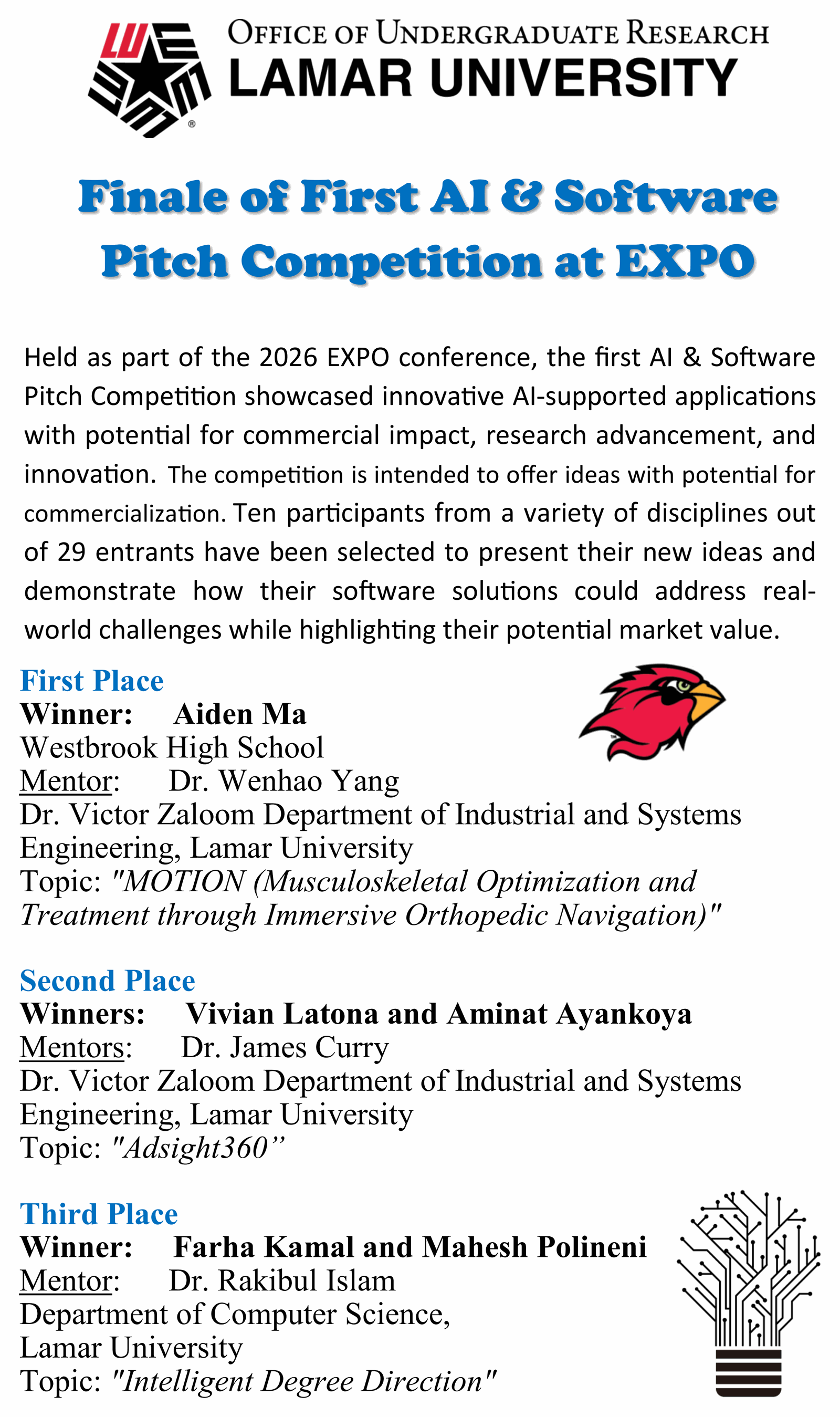
On Friday, May 1, 2026, the Office of Undergraduate Research held the first AI & Software Pitch Competition as part of the Lamar EXPO conference, in the Neches Room of the Setzer Student Center. Aiden Ma, a high school researcher from Westbrook High School working in the XRAI Lab under my mentorship, won First Place with MOTION — Musculoskeletal Optimization and Treatment through Immersive Orthopedic Navigation.
The competition
The competition was built around AI-supported software with real commercial potential, not classroom demos: entrants had to show how their solution addressed a real-world problem and what its market value would be. Twenty-nine students entered, and ten finalists from a range of disciplines were selected to pitch live.
| Place | Winner(s) | Mentor | Topic |
|---|---|---|---|
| First | Aiden Ma (Westbrook High School) | Wenhao Yang, Industrial and Systems Engineering | MOTION (Musculoskeletal Optimization and Treatment through Immersive Orthopedic Navigation) |
| Second | Vivian Latona and Aminat Ayankoya | James Curry, Industrial and Systems Engineering | Adsight360 |
| Third | Farha Kamal and Mahesh Polineni | Rakibul Islam, Computer Science | Intelligent Degree Direction |
The project
MOTION is an AI-driven AR rehabilitation system. It captures a patient’s movement in real time, compares it against the intended biomechanics of the exercise, and feeds corrections back through an augmented reality interface while the person is still moving — rather than after the fact, in a clinician’s notes. Body tracking supplies the measurement, gamified interaction keeps patients doing the repetitions, and a remote view lets a clinician follow progress between in-person visits. Rehabilitation is a good fit for the competition’s commercial framing, because the exercises that matter most are the ones a patient does at home, without a therapist in the room to correct them.
The work ran from February to March 2026 in the XRAI Lab. The research write-up lives on the Research page, and the conference poster is available here.
Why a high school researcher
Aiden spent two months in the lab and came out with a working system and a pitch that held its own against a field of university students. That is the argument for taking high school researchers seriously: given a real problem, real hardware, and the expectation that the result has to work in front of an audience, they build real things. Congratulations, Aiden.